
Unplanned Downtime Costs Your Business $1.4 Trillion? Here's the Data
Fortune 500 companies lose $1.4 trillion annually to unplanned downtime—62% more than 2019. Discover industry-specific costs and how high performers reduce downtime 40-60%.

Key Takeaways
- Fortune 500 companies lose $1.4 trillion annually to unplanned downtime—a 62% increase since 2019
- Automotive manufacturing faces the highest hourly downtime cost at $2.3 million ($600 per second)
- High-performing facilities achieve 40-60% downtime reduction through preventive maintenance programs
- Investment in predictive maintenance delivers 10:1 to 30:1 ROI within 12-18 months
Fortune 500 companies lose $1.4 trillion annually to unplanned equipment downtime. That’s not a typo—trillion, with a T. And it’s 62% higher than 2019 levels.
This isn’t just a maintenance problem. It’s a business survival problem.
The facilities that figured this out years ago now run circles around competitors still stuck in reactive mode. They’re not working harder. They’re working smarter—and the numbers prove it.
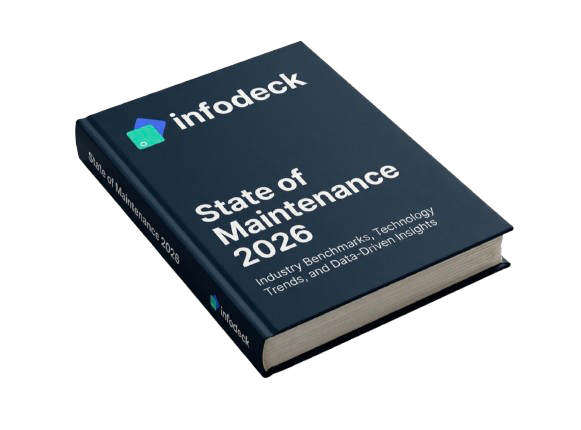
Download the complete State of Maintenance 2026 report for industry benchmarks, vertical-specific data, and implementation frameworks from our comprehensive research.
The Trillion-Dollar Wake-Up Call
The data is stark. According to Siemens’ True Cost of Downtime research, unplanned downtime now costs Fortune Global 500 companies 11% of their yearly turnover—almost $1.5 trillion combined.
That’s not some abstract industry statistic. It breaks down to real numbers:
| Metric | 2019-2020 | 2024-2025 | Change |
|---|---|---|---|
| Total Fortune 500 downtime cost | $864 billion | $1.4 trillion | +62% |
| Average cost per facility | $78 million | $129 million | +65% |
| Average cost per Fortune 500 company | $1.7 billion | $2.8 billion | +65% |
| Revenue impact | ~7% | ~11% | +4 pts |
The acceleration is alarming. In just five years, downtime costs jumped by nearly two-thirds. What changed?
Why Downtime Costs Exploded
Three factors converged to make equipment failures more expensive than ever:
1. Workforce Crisis 69% of maintenance professionals are over 50 years old. When experienced technicians retire, institutional knowledge walks out the door. New hires take longer to diagnose problems that veterans could identify in minutes.
2. Supply Chain Fragility Post-2020 supply chain disruptions extended mean time to repair (MTTR). Parts that arrived in 2 days now take 2 weeks. Every day waiting for a critical component is another day of lost production.
3. Automation Complexity Modern equipment is more productive—and more interconnected. When one system fails, it cascades. A single sensor failure can halt an entire production line.
Industry-Specific Downtime Costs: Where Do You Stand?
Not all downtime is created equal. The hourly cost varies dramatically by sector:
Tier 1: Critical Operations ($1M+ per hour)
| Industry | Hourly Cost | Per Minute | Per Second |
|---|---|---|---|
| Automotive Manufacturing | $2.3 million | $38,333 | $639 |
| Data Centers | $1.0 million | $16,667 | $278 |
| Semiconductor Fab | $1.0-3.8 million | $16,667-63,333 | $278-1,056 |
| Large-Scale Manufacturing | $260,000+ | $4,333 | $72 |
At $600 per second, automotive plants lose $36,000 in the time it takes to read this sentence. Every minute of hesitation on a maintenance decision costs more than most monthly CMMS subscriptions.
Tier 2: High-Impact Operations ($10K-$260K per hour)
| Industry | Hourly Cost | Key Drivers |
|---|---|---|
| Food & Beverage | $30,000-$100,000 | Spoilage, regulatory penalties |
| Pharmaceutical | $50,000-$500,000 | Batch loss, compliance violations |
| Oil & Gas | $50,000-$220,000 | Well production loss, safety incidents |
| Healthcare | $5M+ in fines | Joint Commission violations, patient safety |
Healthcare is unique—downtime costs aren’t just revenue. A single equipment failure can trigger Joint Commission citations, CMS penalties, and malpractice exposure. The $5 million figure represents annual compliance violation costs, not hourly rates.
Tier 3: Standard Facilities ($2,500-$30,000 per hour)
| Facility Type | Hourly Cost | Annual Impact (800 hrs downtime) |
|---|---|---|
| Commercial Real Estate | $2,500-$10,000 | $2-8 million |
| Education Campus | $3,000-$8,000 | $2.4-6.4 million |
| Hospitality/Hotels | $5,000-$15,000 | $4-12 million |
| Retail | $5,000-$20,000 | $4-16 million |
Even “lower cost” facilities face millions in annual downtime impact. A university campus losing $5,000 per hour across 800 hours of annual downtime sees $4 million in losses—enough to fund an entire CMMS implementation multiple times over.
The Math That Changes Everything
Here’s what CFOs need to understand: emergency repairs cost 150-300% more than planned maintenance.
Research from Verdantix breaks down the cost differential:
| Maintenance Type | Labor Cost | Parts Cost | Production Loss | Total Cost Index |
|---|---|---|---|---|
| Planned/Scheduled | Base rate | Standard | Minimal (scheduled) | 1.0x |
| Unplanned/Emergency | 1.5-2x overtime | 1.5-3x rush shipping | Full production loss | 2.5-4x |
A $2,000 scheduled repair becomes an $8,000 emergency when you factor in:
- Weekend/overnight overtime rates
- Expedited shipping for parts
- Lost production during repair
- Secondary damage from cascading failures
- Quality defects from restart issues
This is why the ROI case for preventive maintenance is so compelling. You’re not spending more money—you’re spending it earlier, when it costs less.
How High Performers Achieve 40-60% Downtime Reduction
Organizations implementing comprehensive preventive maintenance strategies achieve 25-40% reductions in total maintenance costs while improving equipment reliability by 60-80% compared to reactive approaches.
The data on what works is clear:
Prevention Investment ROI
| Strategy | Implementation Cost | Downtime Reduction | ROI Timeline |
|---|---|---|---|
| Basic Preventive Maintenance | Low | 30-50% | 8-16 months |
| Condition-Based Monitoring | Medium | 40-60% | 12-18 months |
| Predictive Maintenance (IoT + AI) | Higher initial | 50-70% | 12-24 months |
95% of predictive maintenance adopters report positive ROI, with 27% achieving full amortization within just one year. Leading organizations achieve 10:1 to 30:1 ROI ratios within 12-18 months.
Download the Full Report
Get the complete State of Maintenance 2026 report with all benchmark data and implementation frameworks.
Download Free ReportSee It In Action
Ready to join the facilities teams achieving 75% less unplanned downtime? Start your free 30-day trial.
Start Free TrialThe Five Practices of High Performers
Based on our State of Maintenance 2026 research, facilities achieving best-in-class downtime metrics share five common practices:
1. They Measure What Matters High performers track MTBF (Mean Time Between Failures) and MTTR (Mean Time to Repair) religiously. You can’t improve what you don’t measure.
System Availability = MTBF / (MTBF + MTTR)

Example:
- MTBF of 500 hours, MTTR of 4 hours = 99.2% availability
- MTBF of 200 hours, MTTR of 8 hours = 96.2% availability
That 3% difference? In a facility running 8,760 hours annually, it’s 263 hours of additional uptime.
2. They Automate Scheduling Manual PM tracking via spreadsheets guarantees missed tasks. High performers use automated work order scheduling that triggers based on time, usage, or condition thresholds.
3. They Build Knowledge Systems When a veteran technician retires, does their knowledge go with them? High performers capture troubleshooting procedures, failure patterns, and repair histories in their CMMS system—creating institutional memory that survives personnel changes.
4. They Start Smart with Predictive Not every asset needs IoT sensors. High performers identify their most critical (highest downtime cost) equipment first, prove ROI there, then expand. Our guide on IoT sensors for predictive maintenance covers the prioritization framework.
5. They Connect Systems Maintenance doesn’t exist in isolation. Integrating CMMS with inventory management ensures parts are available when needed. Connecting to building automation systems enables condition-based triggers. The ecosystem approach multiplies individual tool value.
Calculating Your Facility’s Downtime Cost
Want to know what downtime actually costs your organization? Here’s the formula:
Direct Downtime Cost Calculation
Hourly Downtime Cost =
  Lost Production Value +
  Emergency Labor Premium +
  Rush Parts Markup +
  Secondary Damage Risk +
  Quality/Compliance Penalties
Industry Benchmark Calculator
Use these multipliers based on your sector:
| Facility Type | Base Revenue | Downtime Multiplier | Est. Hourly Cost |
|---|---|---|---|
| Manufacturing | Revenue/operating hours | 1.5-2.0x | Calculate |
| Healthcare | Daily billing + fines | 2.0-3.0x | Calculate |
| Commercial Office | Tenant revenue impact | 0.8-1.2x | Calculate |
| Hospitality | RevPAR × rooms affected | 1.2-1.5x | Calculate |
For a detailed ROI calculation specific to your facility, see our CMMS ROI calculation guide or request a customized assessment.
The Prevention Payoff: Real Numbers
Let’s make this concrete with a mid-size manufacturing facility example:
| Metric | Before CMMS | After CMMS (18 months) | Impact |
|---|---|---|---|
| Unplanned downtime (hours/year) | 800 | 320 | -60% |
| Downtime cost ($50K/hr) | $40 million | $16 million | -$24 million |
| Emergency repair incidents | 45/year | 12/year | -73% |
| PM compliance rate | 45% | 92% | +47 pts |
| MTBF (critical equipment) | 350 hours | 680 hours | +94% |
| CMMS + implementation cost | — | $180,000 | — |
| Net first-year savings | — | — | $23.8 million |
That’s a 132:1 ROI. Even conservative scenarios with smaller facilities show 10:1 to 30:1 returns.
What’s Next: Taking Action
The $1.4 trillion downtime crisis isn’t inevitable. Every dollar of those losses represents a prevention opportunity someone missed.
The facilities winning today started their prevention journey years ago. The good news? Modern CMMS platforms compress implementation timelines dramatically. What took 18 months in 2015 now takes 60-90 days with the right approach.
Your Three Next Steps
1. Benchmark Your Current State Download the complete State of Maintenance 2026 report for industry benchmarks to compare against your facility’s downtime metrics.
2. Calculate Your Downtime Cost Use our ROI calculator to quantify what unplanned downtime actually costs your organization—not an industry average, your specific numbers.
3. Assess Your Prevention Readiness Book a demo with our solutions team to evaluate your current maintenance maturity and identify the highest-impact opportunities for your facility.
The facilities that act now will compound their advantage over the next five years. The question isn’t whether to invest in prevention—it’s how much competitive ground you’re willing to lose while you wait.


